绝命毒师第五季
Ecuadorian president to pay state visit to China; trip to consolidate high‑level mutual trust, forge more cooperation consensus: expert_我的网站

一 |
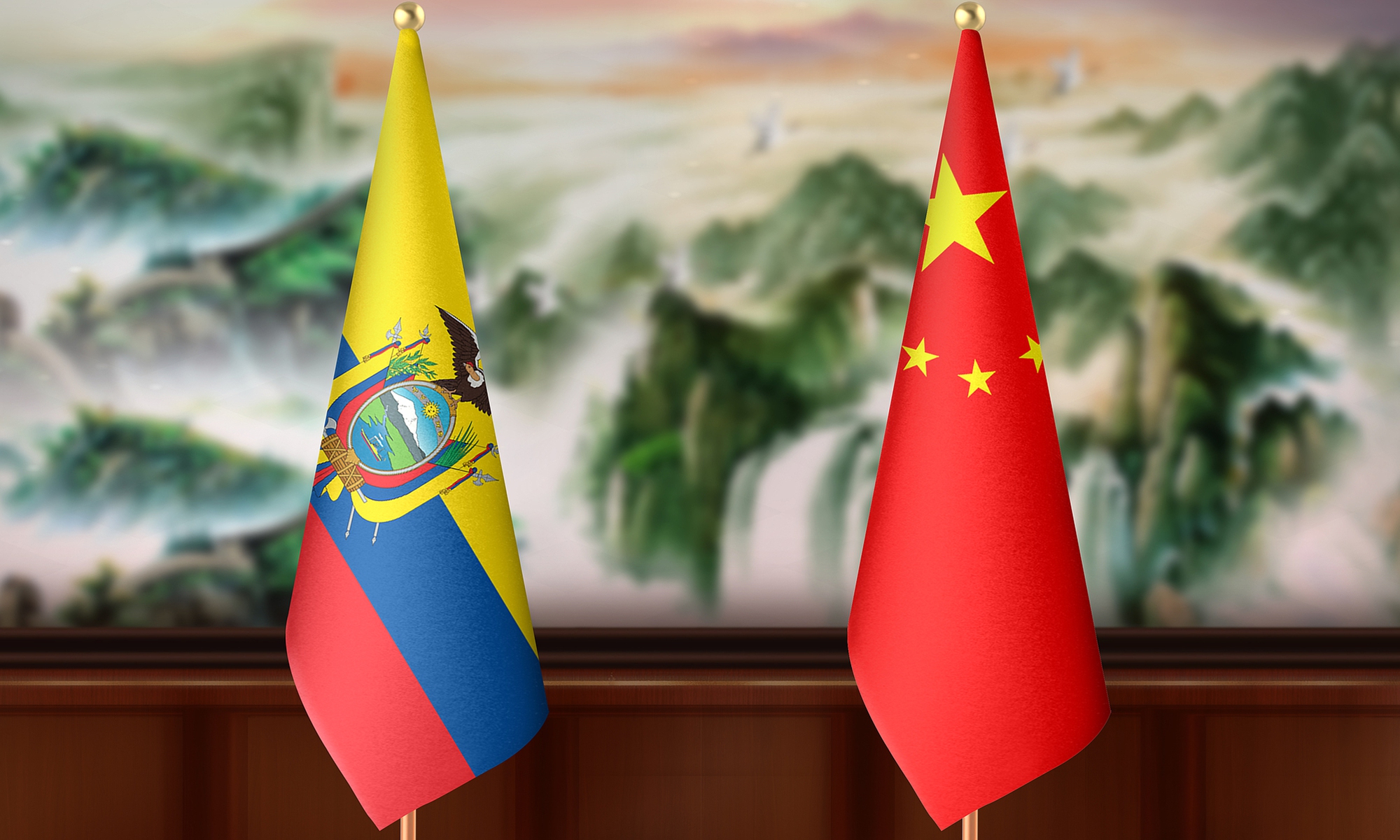
The Chinese national flag and the Ecuadorian national flag. Photo: VCG
At the invitation of Chinese President Xi Jinping, President of the Republic of Ecuador Daniel Roy-Gilchrist Noboa Azín will pay a state visit to China from August 16 to 23, a Chinese foreign ministry spokesperson announced on Friday.
Noting that 2026 marks the 10th anniversary of the China-Ecuador comprehensive strategic partnership, the Chinese spokesperson said that China hopes the visit will help further consolidate political mutual trust between the two countries, carry forward the traditional friendship, and achieve new progress in the comprehensive strategic partnership for the benefit of the two peoples.
The spokesperson said Ecuador is an important Latin American country, and that the two sides have signed a document on Belt and Road cooperation and a free trade agreement, practical cooperation in various areas has been fruitful, and the friendship between the peoples has been deepening.
A release from Ecuador's Ministry of Foreign Affairs notes that the China leg serves as the first stop of his Asia tour, which will also take him to Vietnam and Singapore. The statement adds that the state visit to China is intended to deepen strategic ties and advance key initiatives spanning trade, investment, infrastructure, energy, technology and sustainable‑development cooperation.
Citing Ecuadorian foreign minister Roberto Kury, local media outlet Vistazo reported that the agenda would include Chinese investment interest in energy and mining, as well as Quito's aim of boosting its exports.
According to the Chinese Foreign Ministry, the upcoming visit will be President Daniel Noboa's first state visit to China. It's also President Noboa's second visit to China following his initial trip in June 2025 for the Annual Meeting of the New Champions in North China's Dalian.
During Noboa's last China visit, he met with the Chinese leader in Beijing. The two heads of state jointly witnessed the signing of the cooperation plan between China and Ecuador on jointly promoting Belt and Road cooperation.
Ecuadorian digital outlet Primicias wrote that the trip will mark a new chapter in the bilateral relationship that Ecuador has consolidated with one of its key economic partners.
"In recent years, China‑Ecuador relations have maintained steady growth. This upcoming visit is expected to further consolidate high‑level political mutual trust between the two countries and forge top‑level consensus for further cooperation in the next phase," Pan Deng, director of the Latin America and Caribbean Region Law Center at the China University of Political Science and Law, told the Global Times on Friday.
Meanwhile, the visit will also help strengthen the bilateral institutional cooperation network, translate cooperation plans into concrete outcomes across niche sectors, and establish a multi‑tiered dialogue mechanism covering governments, enterprises and academia, Pan noted.
"Pragmatic cooperation between China and Ecuador has outgrown fragmented, ad hoc short‑term projects, entering a new era of long‑term cooperation that is institutionalized, regular and scalable," Pan added.
According to China's Ministry of Commerce, the China‑Ecuador Free Trade Agreement was signed on May 11, 2023 and officially entered into force on May 1, 2024. Ecuador thus became China's 27th free‑trade partner and the fourth for China in Latin America.
China has, for consecutive years, stood as Ecuador's second‑largest trading partner. Figures from China's Ministry of Foreign Affairs show that the bilateral trade volume stood at $17.33 billion in 2025, marking a 24‑percent year‑on‑year rise. For the January‑April period of 2026, bilateral trade totaled $6.28 billion, representing nearly 20‑percent year‑on‑year growth.
Pan noted that China‑Ecuador cooperation represents a typical model of complementary development. China boasts strengths in the market, production capacity, technology and capital, while Ecuador is endowed with high‑quality agricultural and marine resources, clean‑energy potential and a favorable Pacific geographic location. The two sides form a sound partnership based on mutual benefit and win‑win outcomes.
Specifically, Ecuador's agricultural produce, aquatic products and specialty resources steadily continue to enter the Chinese market. In terms of investment and infrastructure, Chinese players have long taken part in local livelihood projects and infrastructure building that align with Ecuador's actual development needs, he noted.
Ahead of the Ecuadorian president's state visit to China, Uruguayan President Yamandu Orsi travelled to China in February as Latin America's first head of state to visit China in 2026. During Orsi's visit, the two sides issued a joint statement on deepening their comprehensive strategic partnership, and signed more than 10 cooperation documents covering investment, trade and other fields.
Much like China‑Uruguay ties, evolving China‑Ecuador relations demonstrate that Latin American countries can pursue development‑oriented practical cooperation through independent diplomacy, without being forced to take sides or sacrificing their sovereignty and economic autonomy, said Pan.
Amid rising trade protectionism, geopolitical disruptions and heightened market uncertainties, the two sides uphold open cooperation and mutual benefit, offering the Global South a viable pathway for cooperation rooted in equality, mutual benefit, stability and no political strings attached, he added.
。 The Chips Act is "a pre-cursor to further escalations with China in order to flip this dynamic, knowing that the US will not be able to adequately defend Taiwan,” US-based financial commentator Tom Luongo tells Sputnik, referring to US-Chinese tensions over Taipei, which escalated after House Speaker Nancy Pelosi’s visit to the island last week.,"The US will defend Taiwan through a number of hybrid war tactics, including sanctions and tariffs as well as monetary policy, while simultaneously making like they can and will defend Taiwan militarily. For now, Taiwan is important, this bill is saying we need to ensure it is less important. This vulnerability, in my opinion, was deliberately pursued by forces within our government to lead us to this unfolding crisis. We always wanted a casus belli against China. Taiwan is the perfect trip wire for further war," Luongo explains.,He ventured to say that “it may even have been the reason” Pelosi visited Taiwan “to ratchet up the tension and ensure the bill’s passage,” adding that “at this point, things are so murky, trying to divine what anyone’s motivations are on Capitol Hill, other than surviving the mid-terms, is a fool’s errand.”,Earlier this week, US President Joe Biden signed a bipartisan bill that aims to boost the country’s competitiveness with China by investing $280 billion in domestic semiconductor manufacturing and science research.,Speaking at the signing ceremony outside the White House on Tuesday, Biden claimed that “the future of the chip industry is going to be made in America,” adding, “Today is a day for builders. Today America is delivering.”,Dubbed the Chips and Science Act, the bill includes more than $52 billion for US companies producing computer chips, as well as billions more in tax credits to encourage investment in semiconductor manufacturing.,WorldUS New Chips Law Will Undermine Global Supply Chains: Chinese Foreign MinistryYesterday, 12:00 GMT,The document also stipulates allocating tens of billions of dollars to fund scientific research and development and to spur the innovation and development of other US technology.,"Trade tensions with China and the war hysteria [around] Taiwan will make US susceptible to disruptions in chip availability that can have wide ranging disturbances across industries," says Dr. Sunita Raju, a professor of economics and Chairperson of the Indian Institute of Foreign Trade. "While the CHIPS Act is an effort to maintain technology leadership position of US, it is also an effort to stem the US lagging behind Taiwan, Korea and China in recent times in chip manufacturing.",The Chips Act is "a clear departure for US industrial policy to provide subsidies and incentives to a specific industry. The compulsion now is driven by geopolitical tensions (US-China trade war, China-Taiwan-US confrontation), strategic significance of chips in manufacturing across industries (particularly post COVID) and its applications for defence and national security concerns," says Dr. Raju.,The professor explains that the purpose is to attact investment from major chip manufacturers and establish semiconductor fabrication plants in the United States.,"The 'Fab less' model that the US followed in the past made US gain a dominant market position in the R&D, IP and design capability of the value chain of semiconductor industry but resulted in less than 12% in wafer fabrication (capital intensive) and 2% in Assembling, Packaging &Testing (Capital & labour intensive) (SIA, 2021). US share in global installed capacity of semiconductor industry is less than 12%, while the global sale of semiconductor sales (Fab less plus IDMs) is 48%. As a result, growth in installed capacity of US was outpaced by Asian countries," Dr. Raju explains.,Modi Vows to Develop India as Chip Hub as Gov't Sets $300Bn Target in Electronics Manufacturing 4 July, 20:01 GMT,Meanwhile, Luongo says that the bill “will have an effect on semiconductor production” in the US, but “the question is whether it is cost-effective to actually do it.”,“It was a strategic mistake to offshore all of our chip production. For everything outside of the bleeding edge in power management – phones, data centers, etc. – older technology is just fine. Remember that most of these big chips are designed here in the US, manufacturing happens overseas. […] The production of most of your iPhone happens here in the US, the assembly of the parts happens in China. This point is lost in all of the noise,” he points out.,Luongo describes the bill as “just a start” in terms of the US’ effort to get the better of China in the race to dominate the high-tech sector.,“The turnaround will take time certainly, there is no easy fix here (…) If the US is serious about gaining real market share and competitiveness in manufacturing, then a lot of roadblocks currently in place will need to end,” the commentator notes.,He went on to argue that the global market for chips currently looks “the way it does because of US technology barriers through trade deals, sanctions and the like.” Luongo adds that US foreign policy “will now hinge on continuing to try and delay and slow down the rise of competition” and that “being pushed out of markets like central Asia and falling behind in Africa, etc. isn’t a good sign.”,According to him, “the real problem now is that the US is going hyper-belligerent to maintain its control when it should have looked inward to solve its internal problems years ago. [Former US President Donald] Trump tried and failed to make meaningful reforms.”。
Current article:http://ofxq5.senbatuqiuzhuanlanrilao.sbs/list_esd7/xmi7q.html
Published on:00:00:00